
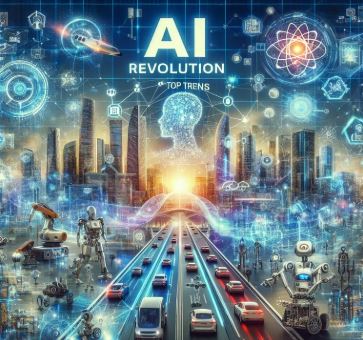

(Tech News, 2025) — The year 2025 marks a turning point in the evolution of artificial intelligence, as major technology companies unveil next-generation AI systems that seamlessly integrate into daily life. From personal assistants that understand emotions to advanced generative models capable of creating art, code, and scientific research, AI is rapidly transforming how humans work, learn, and communicate.
The rise of autonomous AI agents has become one of the most exciting developments this year. These agents can independently perform complex tasks such as managing finances, optimizing business operations, or even conducting experiments in virtual environments. Industry leaders like OpenAI, Google DeepMind, and Anthropic have all announced breakthroughs in making AI safer, more interpretable, and aligned with human values.
At the same time, innovation in quantum computing and neural chips is pushing the boundaries of processing power. Tech giants are racing to produce smaller, energy-efficient processors that can handle massive datasets at lightning speed. This has opened the door to real-time language translation, enhanced cybersecurity systems, and medical breakthroughs that were once considered impossible.
However, alongside these advances come growing debates about privacy, ethics, and digital dependency. Experts warn that while AI promises incredible benefits, it also requires robust governance and transparency. As 2025 unfolds, the balance between technological progress and responsible innovation will define the next chapter of the digital age.